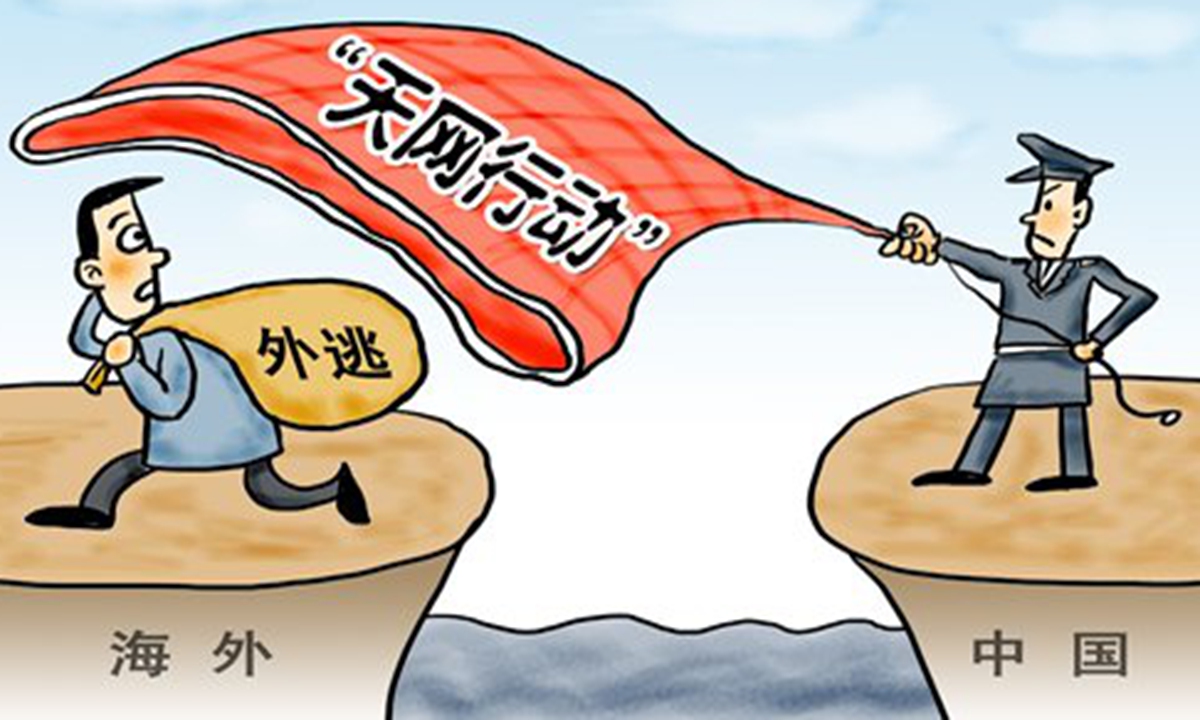
An animated picture features Chinese law enforcement official tracking back a fugitive who flees overseas with his ill-gotten asset during the Skynet operations, China's project to track down fugitives. Photo:VCG
Chinese lawmakers began reviewing a draft law on combating cross-border corruption on Tuesday, a legislation which experts believe would help close legal gaps in investigating overseas corruption, pursuing fugitives and recovering illicit assets, while strengthening international cooperation and corporate compliance.
The draft was submitted for its first reading to the ongoing session of the Standing Committee of the National People's Congress, the country's top legislature, per Xinhua News Agency.
Huo Zhengxin, a professor at the China University of Political Science and Law, told the Global Times that the draft law represents a dedicated piece of legislation within China's anti-corruption legal framework and a major step forward in the country's law-based governance of foreign-related affairs. It will fill a legislative gap in combating cross-border corruption, Huo said.
As Chinese companies expand business overseas, cross-border corruption cases face challenges in obtaining evidence abroad, pursuing fugitives and recovering illicit assets. Existing anti-corruption laws have faced limitations in addressing such cases involving foreign affairs, making such dedicated legislation necessary, Huo said.
Structured into six chapters and 47 articles, the draft sets out the principles, scope and key provisions underpinning China's efforts to combat cross-border corruption. It also defines relevant operational mechanisms and institutional responsibilities, and seeks to strengthen case handling and international cooperation.
The draft further clarifies enterprises' obligations regarding integrity and compliance, and specifies legal liabilities for violations.
As one of the experts involved in drafting the legislation, Huo said a key innovation of the draft is to strengthen international cooperation and corporate integrity and compliance obligations. As evidence, suspects and illicit assets in cross-border corruption cases are often located overseas, the draft provides mechanisms including extradition, mutual legal assistance and repatriation, while aligning with relevant rules under the UN Convention against Corruption (UNCAC), said the expert.
The draft also makes clear that Chinese companies operating overseas, including both state-owned and private enterprises, have legal obligations to uphold integrity and compliance with domestic laws, Huo said.
The legislation would also codify practices accumulated through China's past campaigns against cross-border corruption, such as Sky Net and Fox Hunt operations, turning them into a more systematic legal framework and strengthening the law's deterrent effect, according to Huo.
The draft law is a practical step to regulate the development of cross-border businesses and help build a world-class business environment aligned with market principles, the rule of law and international standards, Xinhua noted.
It is also expected to expand the legal tools available to combat cross-border corruption and help address challenges in detecting corruption, collecting evidence, recovering illicit assets and securing convictions, according to the report.
In January, CCTV News reported on the case of a former senior executive of China National Offshore Oil Corporation, who was accused of accepting large amounts of bribes that were concealed overseas, with a businessman allegedly acting as a "front" to collect the illicit payments.
The draft's explicit corporate integrity and compliance requirements would make it harder for individuals to disguise bribery and other corrupt practices through overseas projects in an attempt to circumvent domestic oversight, while further clarifying the extraterritorial reach of China's anti-corruption laws, Huo said.
The draft also contains provisions to counter the use of foreign countries' domestic anti-corruption laws to exercise "long-arm jurisdiction" over Chinese companies, which Huo described as another important innovation in China's foreign-related legal framework.
China has been deepening its efforts in international anti-corruption cooperation, with 963 corrupt fugitives repatriated to the country in 2025, according to a work report from the country's top anti-graft body, Xinhua reported.
。 为什么今年台风偏爱华东?副高是幕后推手每日商报讯 昨天,作为出伏的第一天,杭州气温也很应景,主城区最高温从此前的接近“高温线”降至32.6℃,随着“简拉维”残余环流进一步减弱西进,今天杭州的气温会比昨天小幅升高,可能会触及高温线。不过,比起气温来说,更需要关注的是台风动向。接下来,“简拉维”影响减弱,但“沙德尔”又要“接棒”登场,浙江省防指防台风应急响应昨天已调整为Ⅲ级。其实,回顾过去一周,四个台风接连生成,第20号台风“简拉维”于周一减弱消散,第21号台风“艾莎尼”也在昨天停编,第19号台风“紫檀”登陆海南省昌江县后、强度逐渐减弱,第18号台风“沙德尔”继续活跃。对于浙江来说,需要注意这个遥远的“海上来客”——“沙德尔”。目前,已进入48小时警戒线。据中央气象台消息,“沙德尔”(强台风级)的中心昨天下午5点钟位于浙闽交界偏东方向约920公里的西北太平洋洋面上,中心附近最大风力14级(45米/秒),预计将以每小时15-20公里的速度向西偏北方向移动,强度变化不大,今天凌晨移入东海东部,之后移速减慢,转向西偏南方向移动,逐渐向浙闽沿海靠近,将于27日夜间至28日上午在浙江象山到福建福清一带沿海登陆(35-42米/秒,12-14级,台风级或强台风级)。“从昨天云图看,‘艾莎尼’的残涡已经汇入‘沙德尔’的输入云带。
二 | 未来沙德尔在北侧的副热带高压引导下,以西行为主,相比之前预报总体有北调趋势。”中国天气网首席气象分析师信欣分析,目前对于台风临近华东的预报还有些分歧,主要是陆地上西环高压对台风向西南引导的力度还不好确认,登陆我国没悬念,只是到底是登陆浙江还是福建,仍然待定。回顾今年的台风发展,似乎“旋风小子”偏爱华东,这是为什么?中国天气网解释,这是由于副热带高压的偏强、偏北,为远洋台风“巴威”“白海豚”扎堆华东,打开了“方便”之门。
三 | 如果按常年副热带高压正常位置来看,它们大可能去的是广东、福建、台湾。对于当下的台风“沙德尔”来说,此时副热带高压本该大幅南撤或主体退回海上,结果现在仍持续偏西偏北,导致“沙德尔”登陆区域仍集中在浙闽沿海,而不是更偏南的区域。受“沙德尔”影响,浙江接下来也将迎来明显风雨影响。
四 | 浙江天气网显示,今明天,东海中南部海域风力逐渐增强到11~13级部分14~16级,台风中心经过的附近海域风力可达17级及以上。浙中南沿海海面今天傍晚起风力逐渐增强到9~10级,明后天继续增强到12~13级、局部14~16级;浙北沿海海面明天风力逐渐增强到9~13级。沿海和浙南地区明后天有大雨暴雨,部分大暴雨,其中温州、台州、丽水东部等地局地特大暴雨。就杭州而言,“沙德尔”的影响会在明天开始体现,一直到周六,全市有一次风雨过程,风雨最强时段集中在周五(28日)。
Current article:http://eqd.chuojianmeniaoyoshangshuang.shop/list_5vj5ldj/cjp.html